DB Design Bureau Home | Technical Drawings | Free-Flight Plans | Aircraft Designed in Australia  

Drawings of Australian aircraft

High quality drawings of Australian-designed aircraft are rare. This is mostly because the aircraft are rare themselves, and there is little information or research available regarding them. But there is also a proliferation of low-quality drawings, particularly here on the internet where a poor quality drawing may be easily copied and appear many times. So it's sometimes difficult to get hold of good drawings for documentation or modelling purposes. On this page I've collected a number of drawings which I've created over the years and combined them all into one resource. 

Having said that, I'm not claiming that all of my drawings included below are perfect. Some of them are just outlines traced from other drawings (but with checks of known dimensions and for consistency between views). However I always try to check my drawings against other references and known dimensions. And some of these drawings are very accurate, since they are based on original factory information and measurements from actual aircraft. I also welcome suggestions for improvements to these drawings if anyone can provide more detailed information.

The drawings are grouped into 2 categories below, the first group are detailed drawings (based on research, original factory drawings and/or measurements from actual aircraft) while the second group are simple outline views (usually traced from company brochures),

There are also some other bits and pieces, with more to come. You can download the drawings in fine detail using Adobe Acrobat. If you don't have this software, you can get the free Acrobat Reader from the Adobe website.

Feel free to let me know how you use these drawings, or if you have any extra information or corrections to add. I'm always trying to improve the quality and accuracy of these drawings. You can send e-mail to derek "at" buckmasterfamily "dot" id "dot" au

A comment about drawing scales:
As these drawings are drafted, they are drawn to a defined scale according to the size of paper on which they should be printed. Adobe Acrobat software is reasonably good at reproducing drawings to their correct size on a range of different printers. However I can't guarantee that they will print out at the correct scale if you print these drawings on paper which is a different size to that intended. For example, if you print a drawing which has been set up to print on A4 paper onto Letter paper, then your printer software will scale the drawing to fit onto the Letter paper and the drawing will not be to accurate scale. So please be aware of this, and take care if you are printing these drawings.


1. Detailed Drawings

Commonwealth Aircraft Corporation Wackett

Back to top

CA-6 Wackett A3-22 on display at the Moorabbin Air Museum. Image © Derek BuckmasterAs World War II loomed on the horizon, Australia needed an aircraft suitable for training the new generation of pilots who would soon be needed to defend the country or fight  with the allied forces in Europe. So the Wackett was developed to meet this need.

The two CA-2 prototypes were initially powered by in-line Gypsy engines, but these turned out to be underpowered.
The solution to this lack of power was to install a Warner Super Scarab radial engine.  In this new form, the CA-6 Wackett met the requirements of the RAAF trainer specification, and 200 Wacketts were constructed and saw service with the RAAF and the Dutch East Indies Air Force (now Indonesia).

You can find more information regarding the Wackett trainer on these websites:
Wikipedia entry for Wackett trainer
RAAF Museum entry for Wackett trainer
ADF Serials website entry for Wackett trainer (includes a history of each aircraft produced)

3-view drawings:
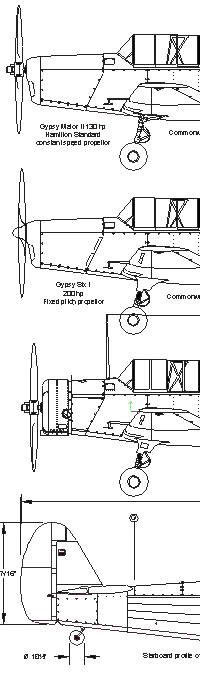
This set of detailed 1:48 scale drawings covers the evolution from the CA-2 prototypes to the CA-6 production version.  These are accurate drawings based on factory information and measurements from actual aircraft.

PDF for A4 paper  (144 KB)
Commonwealth Aircraft Corporation Wirraway
Back to top
CAC WirrawayThe North American Aviation NA-33 advanced trainer (NAA designation NA-16-2K) was produced under license by Commonwealth Aircraft Corporation as the Wirraway.

A total of 755 Wirraway aircraft were ordered under 7 different production orders (CA-1, CA-3, CA-5, CA-7, CA-8, CA-9 and CA-16) in 3 distinct versions (Wirraway I, II and III).

You can find more information regarding the Wirraway on these websites:
Wikipedia entry for CAC Wirraway
RAAF Museum website entry for A20 series Wirraway
ADF Serials website entry for Wirraway

Technical drawings:
These drawings are a "work in progress". I'll be adding new drawings as they are completed and checked.

2a. Wirraway wing stations
This drawing shows the geometry of the Wirraway wing structure, including rib stations and airfoil sections.
PDF for A4 paper (17 KB)
Kingsford Smith Aviation Services KS-1 & KS-2

Back to top

Kingsford Smith Aviation Services KS-2Since the Second World War, Australia has been one of the world's largest agricultural exporters, and this has fueled the demand for agricultural aircraft.

The KS.1 was a post-WWII conversion of the CAC Wackett trainer for top-dressing and spraying. The chemical hopper was placed in front of the pilot, replacing the original front cockpit seat. In this form it did not meet the requirements of agricultural operators who tested it, so the single prototype was developed further to become the KS-3 Cropmaster.

(Photo © Ben Dannecker, used with permission)

3-view drawing:
This detailed 1:48 scale drawing shows the KS.1 Cropmaster aircraft.

PDF for A4 paper

Kingsford Smith Aviation Services KS-3 Cropmaster

Back to top

Kingsford Smith Aviation Services KS-3Following on from the sole KS.1 and KS.2, the KS.3 was the first production version of Kingsford Smith Aviation's Cropmaster.

The KS.3 featured the pilot in the original front seat position of the Wackett, and the hopper was moved to the location of the original rear seat.

The first KS.3 airframe (which was also the KS.1 prototype and the KS.2 prototype before being converted to the KS.3 configuration) has been restored and is on display at the Queensland Air Museum in Caloundra. Their website includes a detailed history of this aircraft.

3-view drawings:
This set of detailed 1:48 scale drawings shows detailed views of the KS.3 Cropmaster aircraft.

PDF for A4 paper (101 KB)

Yeoman Aviation YA-1 Cropmaster

Back to top

Yeoman Aviation YA-1 Cropmaster 250R Series 2The Cropmaster was a further development of the KS-3, featuring a major redesign and retaining only the steel-tube fuselage frame of the CAC Wackett. The Cropmaster went through several developments during its service life, the final version featuring an all-metal wing and all-metal empennage. 3-view drawings:
This set of detailed 1:48 scale drawings covers the development of the YA-1 from its original Wackett-tailed form with wooden wings to the final production version YA-1 Cropmaster 250R.  It also includes some interesting variations including 2 proposed designs which were never built, as well as the one-off Yeoman-Haines 3-seater conversion.

PDF for A4 paper  (1,217 KB)


2. Outline Drawings

Amethyst Falcon

Back to top

The full scale Amethyst Falcon aerobatic ultralight biplane.The Falcon is a single-place aerobatic ultralight biplane. It was designed by Eric Whitney (with the aim that it could be built by a home-builder in a single-car garage) and the stress calculations were carried out by Bill Whitney.

Two Falcons have been constructed to date, the first by Bill Knight (shown in the photo).

3-view drawing:
This is a simple outline drawing at 1:48 scale. Since I drew this, I have come across more detailed information, so I intend to create a more accurate drawing of the Falcon in the future.

PDF for Letter paper (58 KB)
Amsco Monoplane

Back to top

The original (and only) Amsco monoplane outside the factory in Geelong.The AMSCO Sport monoplane is a rare Australian light plane developed by Charlie Pratt and his Aircaft Manufacturing and Supply Company in Geelong in the 1930s. 3-view drawing:
This 1:48 scale drawing was originally created by the late Alex Pedashenko. I have re-drafted Alex's original, and corrected some of the detail around the engine, based on recently published photographs.

PDF for A4 paper (23 KB)

Commonwealth Aircraft Corporation CA-15 "Kangaroo"
The CAC CA-15 in flightThe CA-15 was a prototype fighter developed by CAC in the closing stages of WWII. It represented the peak in piston-powered performance.

The original concept which led to the CA-15 was a development proposal based on the Boomerang fighter and powered by a Pratt & Whitney R-2800. It was realised that an entirely new airframe would be required and so the CA-15 project followed.

With its liquid-cooled Merlin engine, bubble canopy, laminar flow wing and belly-mounted radiator it bears a superficial resemblance to the North American Mustang aircraft, however this is only a coincidence of design since the CA-15 project was developed independently by CAC. The CA-15 was originally intended to be powered by an R-2800 air-cooled radial engine.

You can find more information regarding the CA-15 on these websites:
Wikipedia entry for CA-15
RAAF Museum entry for CA-15
ADF Serials website entry for CA-15
WW2 Aircraft forum entry showing development steps

3-view drawings:
These drawings show the basic outline of the CA-15.
PDF for A4 paper

PDF for Letter paper
Gippsland Aeronautics GA-8 Airvan

Back to top

The Gipplsland Aeronautics GA-8 Airvan. Image © Derek BuckmasterThe GA-8 is an 8 passenger utility plane developed and produced in Australia. It recently received type certification in the USA (becoming the 7th Australian aircraft to achieve this).


3-view drawing:
This is a simple outline drawing of the GA-8.

PDF for A4 paper (17 KB)

Government Aircraft Factory N22 Nomad
GAF N24 NomadThe Nomad was developed during the 1960s as a utility aircraft, able to carry passengers and freight and operate out of unprepared landing strips.
3-view drawing:
This drawing shows the basic outline of the Nomad N22 at 1:72 scale.

PDF for A4 paper (17 KB)


Kingsford Smith Aviation Services PL-7 Tanker Back to top
Kingsford Smith Aviation Services PL-7 TankerAfter developing the KS.1, KS.2 and KS.3 Cropmaster series based on converted CAC Wackett airframes, Kingsford Smith Aviation Services enlisted the innovative design talent of Luigi Pellarini to create a new agricultural aircraft "from the ground up".

This was a purposed-designed twin-tail pod-fuselage sesquiplane and was an ancestor of the Transavia PL-12 Airtruk, also designed by Pellarini. Powered by a Armstrong-Siddeley Cheetah engine of  400 hp, this was a large aircraft with a wingspan of 40 feet 9½ inches.

The PL-7 (the 7th aircraft type designed by Luigi Pellarini) was the first in a fascinating series of purpose-designed agricultural aircraft by Pellarini.

The next evolution was the PL-11 Airtruck, built by Bennett Aviation in Te Kuiti, New Zealand. This design continued with the twin-tailed approach to enable easy loading of the hopper, and also featured the sesquiplane layout, but the lower wing was significantly smaller. Once again Pellarini developed a large and powerful aircraft for agricultural work, with a wingspan of 48 feet powered by a 500 hp Pratt & Witney R1340 Wasp engine (from war surplus Havard trainers). Extensive information on the PL-11 can be found on the Wings Over New Zealand Aviation Forum.

The final development in this "series" was the PL-12 Airtruk (no "c" in the spelling), built by Transavia in Sydney, Australia. Once again this was a completely new design, but following the same principles. A smaller aircraft this time (39 feet 3½ inches wingspan) it was powered with the more common Lycoming IO-540 engine, providing 300 hp. More information on the PL-12 can be found on Wikipedia.

3-view drawing:
This drawing shows basic outlines of the PL-7 Tanker.

PDF for A4 paper (17 KB)


Southern Cross Aviation SC1

Back to top

The SC-1 on display at Moorabbin Air Museum in the 1980'sThe SC1 was a prototype for a 4-place trainer and touring aircraft. It first flew in 1962, but never went into production due to competition from imported trainer aircraft.
The sole prototype has been restored at the Museum of Army Aviation in Oakey, Queensland (on loan from the Australian National Aviation Museum at Moorabbin in Melbourne).
Drawings:
This drawing is based on Joe Vella's drawing originally published in the AHSA Journal, but with extra detail added and checks made from measurements of the actual aircraft while it was in storage at the Australian National Aviation Museum in Moorabbin.
3-view drawing in PDF for A4 paper (29 KB)

PDF for A4 paper showing colour schemes


Back to DB Design Bureau home

First created 18/02/2010  -  Last updated 24/02/2010